
Why Do Snake Plants Grow So Slowly?
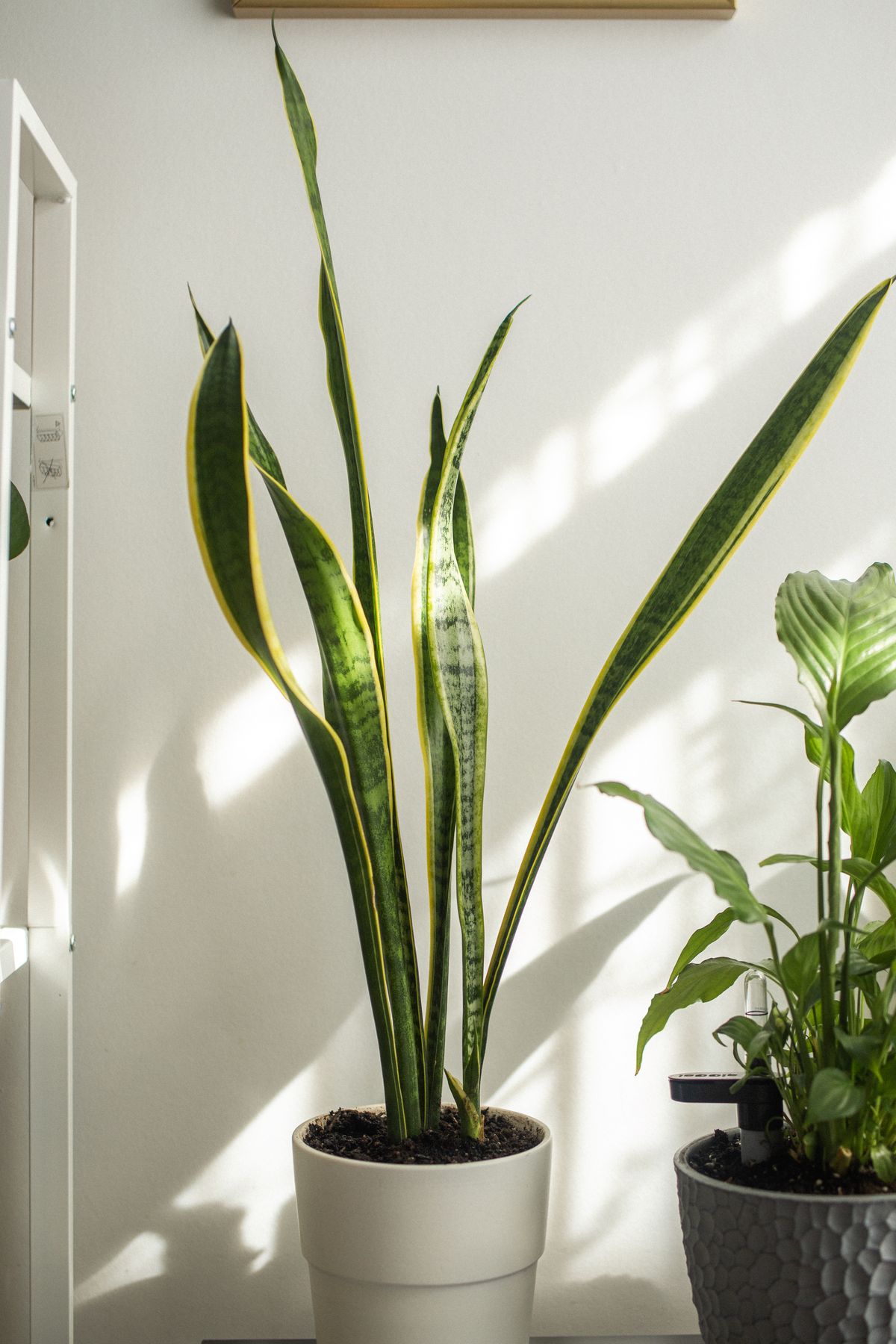
Snake plants grow slowly because of a hard biochemical limit in how CAM photosynthesis works, not primarily because of light or pot size. CAM fixes carbon only at night, storing it as malic acid inside a leaf vacuole of fixed size — a nightly carbon "deposit" capped by how much storage space the leaf has, at roughly three times the energy cost of a plant that photosynthesizes continuously through the day. That ceiling exists even under ideal care.
Most guides list light, water, and pot size as the reasons a snake plant grows slowly, and stop there. Those factors matter, but none of them explain why even a perfectly cared-for snake plant in excellent light still grows a fraction as fast as a pothos in the same room. The real answer is biochemical, not a care mistake. (For the full mechanics of how CAM photosynthesis actually works in this plant — the day/night stomata cycle, the malic acid storage, CAM-idling during drought — the CAM Photosynthesis in Sansevieria guide covers it in depth; this article covers specifically why that cycle caps growth speed.)
Why Do Snake Plants Grow So Slowly in the First Place?
The short version: a standard houseplant using C3 photosynthesis fixes carbon continuously all day, every hour the sun is out. A snake plant using CAM photosynthesis only fixes carbon at night, storing it as an acid, then spends the day converting that stored acid into sugar instead of pulling in fresh carbon dioxide. That single scheduling difference is the root of almost everything about how slowly this plant builds new tissue.
The Storage Cap: Why More Light Does Not Just Mean More Growth
Here is the mechanism most care guides skip entirely, and it is worth understanding precisely because it corrects a very reasonable but wrong assumption. In a CAM plant, the overnight carbon dioxide gets stored as malic acid inside the leaf's vacuoles — specialized storage compartments inside each cell. Vacuole size is physically finite. Once those vacuoles are full for the night, no more carbon can be banked, regardless of how much CO₂ is still available in the air around the plant. Metabolic modeling research on CAM photosynthesis confirms this directly: "the vacuolar storage capacity of the leaf is a major determinant of the extent of the CAM cycle" — the storage tank's size, not the night's length or the air's CO₂ concentration, sets the hard ceiling on how much carbon a CAM plant can process in a single cycle.
This is exactly why doubling a snake plant's light does not double its growth rate the way it might for a plant that photosynthesizes continuously all day. More daytime light helps the plant process the stored acid it already banked overnight more efficiently, but it cannot make that night's storage tank any bigger. The bottleneck sits upstream of daytime light entirely.
The Energy Cost: Why CAM Is Not Just Slower, It Is More Expensive
This is the second piece almost nobody mentions, and it changes how you should think about "why doesn't better care fix this." Running the CAM cycle costs real metabolic energy beyond what a standard daytime-only photosynthesis pathway spends. The same modeling research found CAM operation requires "threefold higher energy consumption at night" compared to processing the equivalent amount of carbon directly during the day. The plant is not just fixing carbon on a delay — it is paying roughly three times the energy bill to do it that way, energy that in a faster-growing C3 plant would otherwise go toward building new leaf tissue.

Put the two mechanisms together and the growth-rate answer becomes concrete rather than vague: a fixed nightly carbon-storage cap, paid for at triple the metabolic cost of continuous daytime photosynthesis, is what makes "slow" the expected outcome for this plant — not a symptom of anything being done wrong.
This is not unique to sansevieria. CAM photosynthesis appears in over 33 plant families, and the same storage-cap-plus-energy-cost combination shows up in cacti, agave, and other succulents that are all, without exception, slow growers by common comparison. When a whole photosynthetic strategy consistently produces slow-growing plants across totally unrelated plant families, that consistency itself is evidence the limit is mechanistic, not incidental to any one species' care.
Is a Bigger Pot the Fix, Like Some Guides Suggest?
No, and this is worth correcting directly since it is a common but backwards piece of advice. An oversized pot does not give the roots more room to "power" faster growth — sansevieria's growth rate is set by the carbon-fixation ceiling described above, not by how much soil volume is available. What an oversized pot actually does is hold more moisture around a root system that is not using it, which is a documented path toward root rot rather than faster growth. Repot only every 2-3 years, and only when roots are visibly escaping the drainage holes or cracking the pot — not in an attempt to speed up a growth rate that a bigger pot cannot influence either way.
So Does Light and Care Matter At All?
Yes, within the ceiling this mechanism sets. 8-10 hours of bright indirect light a day genuinely does produce a visibly faster-growing snake plant than a north-facing room with minimal light — the Royal Horticultural Society's sansevieria growing guide reflects this same expectation of gradual, light-dependent growth even under otherwise correct care. In low light, expect roughly one inch of growth a year. In strong indirect light, expect meaningfully more, though still nothing close to a fast-growing C3 houseplant. Good care moves you toward the top of a narrow range. It does not remove the range's ceiling.
Fertilizer deserves a specific correction here, since it is the fix people reach for most often. Feeding once in spring and once in mid-summer supports overall health, but it cannot meaningfully speed up growth beyond the CAM cycle's own limits, because the constraint is carbon-fixation timing and storage capacity, not a nutrient shortage. More fertilizer does not open up more vacuole space overnight.
Is a Slow-Growing Snake Plant an Unhealthy One?
No — and this is worth stating clearly, since "why is my plant growing so slowly" often carries an unspoken worry that something is wrong. A snake plant putting out one or two new leaves a year, with firm, upright, undamaged foliage, is doing exactly what its biology is built to do. The Snake Plant Growth Cycle guide covers what a healthy growth flush actually looks like stage by stage, so you have a concrete baseline for "normal" rather than comparing it to a fundamentally different plant's pace. If new growth has stopped entirely rather than just slowed, that is a different question the Why Is My Snake Plant Not Growing New Leaves? guide covers directly.
For the species' complete biology and how this growth-rate ceiling fits into its broader drought adaptations, the Sansevieria Plant Botanical Guide and the Sansevieria Trifasciata guide cover it in full.
If you are wondering whether your snake plant's pace is normal: check whether the leaves it does have are firm and upright, not whether it is producing new ones quickly. A slow plant with healthy existing leaves is working exactly as designed.
Care FAQ
Why do snake plants grow so slowly?
Because they use CAM photosynthesis, which fixes carbon only overnight and stores it as malic acid in a leaf vacuole of limited size. A standard houseplant photosynthesizes continuously all day with no such cap. Snake plants also spend roughly three times more energy per unit of carbon fixed at night than a plant fixing carbon directly during the day, so even under perfect care, there is a real biochemical ceiling on how fast they can grow.
Will more light make my snake plant grow faster?
Up to a point, yes — more light supports the daytime half of the CAM cycle. But it cannot remove the nightly storage cap, since that limit is set by the size of the leaf's carbon-storing vacuoles, not by how much light arrives the next day. This is why doubling light does not double growth the way it might for a plant that photosynthesizes continuously.
Is one inch of new growth a year normal for a snake plant?
In low light, yes, and that is not a sign of poor care. In bright indirect light for 8-10 hours a day, growth is faster than that but still modest compared to most common houseplants, since the CAM storage and energy limits apply regardless of light quality.
Can fertilizer make a snake plant grow significantly faster?
No, not meaningfully. Fertilizer supplies nutrients, not the carbon that actually builds new tissue, and the plant's growth rate is capped by its nightly carbon-fixation limit rather than a nutrient shortage. Feeding once in spring and once in mid-summer supports healthy growth; it does not override the underlying biochemical ceiling.
Do all CAM plants grow this slowly?
Most do, for the same underlying reason — nightly carbon storage capped by vacuole size, plus the higher energy cost of the CAM cycle. Cacti, agave, and other CAM succulents share this same general growth ceiling, which is part of why slow growth is such a consistent trait across drought-adapted succulent plants rather than something unique to sansevieria.
Is a slow-growing snake plant less healthy than a fast-growing one?
No. Slow growth in a snake plant reflects a biochemical strategy built for surviving drought, not a health deficit. A snake plant producing one or two new leaves a year, with firm, upright, undamaged leaves, is a perfectly healthy plant operating exactly as its biology intends.